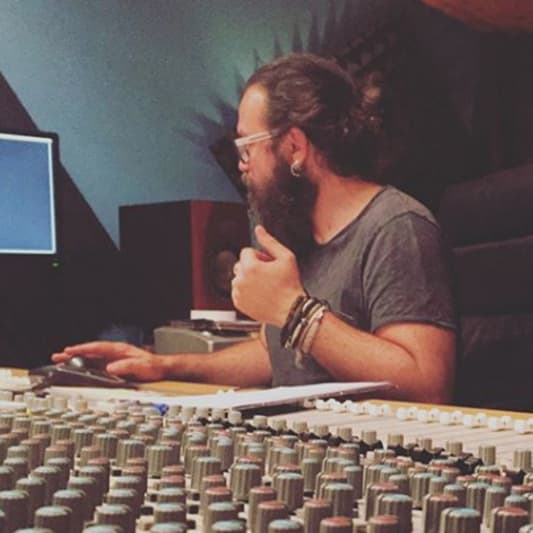
20+ years of professional mixing on an Audient ASP8024 48-channel console. I work exclusively on mixing — rock, metal, alternative and jazz — from a purpose-built studio in Cyprus. Remote sessions via Source-Connect. You send the files, I deliver a mix that sounds like a record. Let's work.
For 20 years I've been doing one thing — mixing records. Not as a hobby, not as part of a package deal. As a full-time profession, in a purpose-built studio I founded in 2005 in Cyprus.
ToneDeaf Studio is centred around an Audient ASP8024 48-channel console and Pro Tools HD. The outboard chain includes an API 2500 stereo bus compressor, Neve 2254R, Retro Sta-Level Gold Edition, Urei 1178 dual peak limiter and dual Empirical Labs Distressors — the kind of analogue signal path that defines the sound of records you already know. Monitoring is through Dynaudio BM15A and Yamaha NS-10M, the industry reference standard for translation across every system.
My credits include engineering the live recording of Iced Earth at the ancient Kourion amphitheatre — a technically demanding session at one of the Mediterranean's most iconic venues. Mixing credits include The Sunryse Sound, Avgi just to name a few.
I specialise in rock, metal, alternative and jazz. These aren't genres I dabble in — they're genres I've spent decades listening to, studying and mixing. That depth of focus translates directly into better results for your music.
You send your files, we align on direction, and I deliver a mix within 3–5 days. One round of revisions is included. Need to be present during the session? Source-Connect makes that possible from anywhere in the world.
Real experience. Real analogue gear.
Would love to hear from you. Click the contact button above to get in touch.
Endorse Nikolas Prokopiou - ToneDeaf3 Reviews

Working with Nikolas has been an integral part of my journey as an artist. As someone young with no studio experience, having him open his door to me and my original music meant everything. His passion, care and wisdom naturally found their way into my songs, he listened deeply, understood my vision, and never tried to reshape it. He brought his own artistry to the table, yet it aligned so seamlessly that it felt like a natural extension of my vision. The sound is raw and detailed, every layer breathes, nothing feels overworked. His talent brought an entirely new dimension to my music.
Working with ToneDeaf Studio and Nikolas Prokopiou was truly an amazing experience. From the first session, the professionalism, creativity, and attention to detail were evident in every part of the process.
Nikolas creates an atmosphere where artists feel comfortable, confident, and inspired to give their best performance. His knowledge of sound engineering, production, and mixing brought my vision to life in a way that exceeded my expectations.
The quality of the studio, the equipment, and the overall workflow made every session both productive and enjoyable. It’s rare to find a sound engi"Working with Nikolas at ToneDeaf Studio was honestly one of the best decisions I made for my music. I sent him two of my originals for mixing — indie/alternative stuff with layered vocals and a lot of atmosphere — and what came back felt like a completely different level.
The thing that surprised me most was how warm and organic everything sounded.
Beyond the sound, Nikolas actually listened. He asked the right questions before touching anything, understood the emotion I was going for, and came back with revisions that were spot-on.
Interview with Nikolas Prokopiou - ToneDeaf
Q: Analog or digital and why?
A: Analogue — but the honest answer is both, working together. The console, the outboard and the tape machine are where the character lives. The way the ASP8024 summing interacts with the API 2500 on the bus, the way the Neve 2254R handles transients, the way the Studer A810 rounds and warms the final print — these are physical processes that add something to audio that no plugin has fully replicated. You can hear it and more importantly you can feel it. That quality is what separates a mix that sounds expensive from one that merely sounds correct. But Pro Tools HD is where the precision lives. Recall, editing, routing flexibility, the ability to work with artists anywhere in the world via Source-Connect — digital makes all of that possible without compromise. The real answer is that the best records have always been made by people who understood both worlds and used each one for what it does best. Analogue for character, warmth and weight. Digital for precision, flexibility and recall. At ToneDeaf Studio that's exactly how we work — the signal path is analogue, the infrastructure is digital, and the result is the best of both.
Q: What's your 'promise' to your clients?
A: I will treat your music with the same seriousness and commitment that you put into making it. You will always know where your project stands. Communication will be clear, honest and prompt — no chasing, no silence, no surprises. Your mix will be built on a genuine analogue signal path, with twenty years of experience behind every decision. Not a preset, not a template — a mix that was made specifically for your music. And if something isn't right, we fix it. The revision round isn't a formality — it's a commitment that you walk away with a mix you're proud of. That's the promise. Every project, every time.
Q: What do you like most about your job?
A: The moment a mix comes together and suddenly sounds inevitable — like it could never have sounded any other way. That moment when the low end locks, the vocals sit perfectly in the picture and every element has its own space without fighting for attention. It happens differently on every record and it never gets old. I also love the trust that comes with the work. An artist hands you something deeply personal — months or years of writing, rehearsing and recording — and asks you to bring it to its full potential. That responsibility is something I take seriously every single time. When they hear the mix back and it exceeds what they imagined, that's the best part of this job. And honestly — sitting behind the ASP8024 every day. Twenty years in and I still find it genuinely satisfying to work on a real console with real outboard. There's a physical, tactile quality to analogue mixing that no screen can replicate. It keeps the work feeling like craft rather than just a task.
Q: What's the biggest misconception about what you do?
A: That mixing is just turning knobs until it sounds louder. Mixing is decision-making. Hundreds of small, interconnected decisions — each one affecting everything around it — that collectively determine whether a record feels alive or flat, whether the emotion of a performance translates or gets buried, whether a song hits the way the artist intended or falls short of its potential. The second misconception is that analogue gear is just nostalgia. The console, the outboard, the tape machine — these aren't vintage decoration. They interact with audio in ways that are physically and mathematically different from plugins. The way a real transformer saturates, the way a VCA compressor breathes, the way a tape machine rounds transients — these are characteristics that took decades to understand and that still define what people mean when they say a record sounds expensive. And finally — that a mix engineer just makes things sound good. The real job is making things sound true. True to the artist's vision, true to the emotion of the performance, true to the genre. Sounding good is a byproduct of getting that right.
Q: What questions do you ask prospective clients?
A: What does this record mean to you? That question tells me more about the project than any technical detail and shapes every decision I make from the moment I open the session. What genre and style is the project, and who are your sonic references? What do you feel the rough mix is missing? Where does it fall short of what you hear in your head? How was it recorded — what room, what gear, what DAW? That context helps me understand what I'm working with before I open a single file. How many tracks are in the session — are stems grouped or are you sending individual tracks? Do you have a deadline — album release, label submission, sync placement? Have you worked with a mixing engineer before? If so, what worked and what didn't? Do you want to be present during the mix via Source-Connect, or do you prefer to receive the mix and give notes asynchronously?
Q: What advice do you have for a customer looking to hire a provider like you?
A: Listen to samples before you reach out — not just for sound quality, but for feel. The technical side is table stakes at this level. What you're really looking for is whether the engineer understands the emotional intent of music like yours. Come prepared with references. Two or three tracks that represent the sound you're after will tell me more about your vision in thirty seconds than a paragraph of description. The clearer your direction, the better your mix. Make sure your tracks are well recorded. A great mix starts with good raw material — I can shape, balance and enhance what's there, but I can't fix fundamental recording problems in the mix. If you're unsure about your recordings before sending, ask me. I'll give you an honest assessment. Trust the process. Give the engineer room to work and reserve your feedback for the revision round. First impressions of a mix are often emotional reactions that settle once you've lived with it for a day. Sleep on it before you send notes. Finally — hire someone whose work you genuinely admire, whose communication feels straightforward, and whose experience matches the ambition of your project. A great mix is a collaboration. The right engineer will make you feel confident from the first conversation.
Q: If you were on a desert island and could take just 5 pieces of gear, what would they be?
A: Audient ASP8024, Pro Tools HD, API 2500, Empirical Labs Distressor, and a pair of Yamaha NS-10M. Console to mix on, a system to run it through, the best bus compressor ever made, a Distressor because it works on everything, and NS-10s because if it sounds good on those it sounds good anywhere. And I'd probably find a way to smuggle the Studer in as carry-on.
Q: What was your career path? How long have you been doing this?
A: I've been working in professional audio for over twenty years. What started as a deep passion for music and sound gradually evolved into a full-time profession. I built ToneDeaf Studio from the ground up in 2005 — assembling the equipment, treating the room and developing the workflow that the studio still runs on today. Over the years I've worked across recording, live sound and mixing, which gave me a broad technical foundation. Eventually mixing became my primary focus — it's where my instincts are sharpest and where I do my best work. Credits along the way include engineering the live recording of Iced Earth at the ancient Kourion amphitheatre, and mixing work for The Sunryse Sound, Avgi and Nekhrah. Twenty years in, the work is still what it always was — sitting behind a console, serving the music, and delivering something the artist is proud of.
Q: How would you describe your style?
A: Transparent but characterful. I don't impose a sound — I build a mix that feels like the natural, fully realised version of what the artist already had in mind. The analogue chain adds weight and depth without drawing attention to itself. Every element sits where it should, the low end is controlled and physical, and the mix breathes dynamically rather than being squeezed into a wall of sound. The goal is always the same — when the artist hears it back, it should feel inevitable. Like it could never have sounded any other way.
Q: Which artist would you like to work with and why?
A: Tool. Their records represent everything I find most interesting about mixing — unconventional arrangements, extreme dynamic range, and a low end that is simultaneously precise and crushing. Adam Jones's guitars alone are a masterclass in frequency management. What Joe Barresi did with "10,000 Days" and "Fear Inoculum" — the space, the weight, the refusal to over-compress — is the kind of mixing philosophy I identify with completely. Getting those elements to sit together on an analogue console would be a deeply satisfying technical and artistic challenge.
Q: Can you share one music production tip?
A: Trust your low end, but always check it in mono. More mixes are ruined by bass frequencies that sound powerful in stereo but disappear on a phone speaker or a club system than by any other single issue. Collapse your mix to mono regularly throughout the session — if the low end still hits, you're building on solid ground. If it doesn't, fix it before you do anything else.
Q: What type of music do you usually work on?
A: Rock, metal, alternative and jazz. These are the genres I've spent twenty years immersed in — listening, studying and mixing. From the aggressive low end density of metal to the dynamic subtlety of jazz, they sit at opposite ends of the spectrum, which has given me a unusually broad set of ears and instincts that benefit every project I work on.
Q: What do you bring to a song?
A: Twenty years of listening, studying and making decisions that serve the music rather than the engineer's ego. What I bring technically is a genuine analogue signal path — a console, real outboard, and a tape machine — that adds weight, depth and character that purely digital mixing simply cannot replicate. The API 2500 on the drum bus, the Neve in the chain, the Distressors and Urei breathing on the right elements — these aren't cosmetic choices. They shape the physical feel of a mix in a way that listeners sense even if they can't name it. What I bring artistically is perspective. After two decades of mixing rock, metal, alternative and jazz, I've developed instincts for where a song needs to breathe, where it needs to hit, and where to get out of the way. I don't impose a sound — I find the sound that was already in the music and bring it forward. What I bring professionally is clarity and honesty. You'll always know where your project stands, what to expect and when to expect it. No surprises, no excuses — just a focused engineer who takes your music as seriously as you do.
Q: What's your typical work process?
A: Every project starts with a conversation. Before I touch a fader I want to understand your music — what you're going for, what references inspire you, and what you feel the rough mix is missing. That context shapes every decision I make. Once we're aligned, you send your session files and I get to work. Your tracks go through a purpose-built analogue signal path — Audient ASP8024 console, API 2500 on the bus, Neve and Distressors in the chain, with final print captured through an RME ADI-2 FS converter. Every element of the mix gets the attention it deserves, with the weight and depth that only a real analogue console can deliver. You receive your mix within 3–5 days. One round of revisions is included — if something isn't sitting right, we fix it. If you want to be present during the session, Source-Connect puts you in the room virtually, wherever you are in the world. The goal is simple: you send me raw tracks and get back a mix that sounds like a record — one that translates on every system, from studio monitors to phone speakers, and represents your music at its absolute best.
Q: What other musicians or music production professionals inspire you?
A: Andy Wallace, Chris Lord-Alge, Bob Rock, Joe Barresi and Alan Moulder — engineers who built their reputations mixing rock, metal and alternative records that still sound definitive decades later. Moulder's work with Smashing Pumpkins, Nine Inch Nails and My Bloody Valentine shaped the sound of alternative music as we know it. On the jazz side, Rudy Van Gelder, whose recordings for Blue Note set a standard for intimacy and presence that has never really been surpassed. What they all share is a philosophy of serving the music rather than imposing a sound — which is the same principle that guides everything I do at ToneDeaf Studio.
Q: What's your strongest skill?
A: Balancing the technical and the emotional in a mix. Knowing when a compressor setting is a technical decision and when it's a musical one — and understanding that the best moves are usually both at the same time. Specifically, my strongest skill is low end control. Getting the kick and bass to lock together, translate across every playback system and hit with the kind of physical weight that makes a mix feel expensive — that's where two decades of working on a real analogue console pays off in ways that are immediately audible.
Q: Tell us about your studio setup.
A: ToneDeaf Studio is built around an Audient ASP8024 48-channel console and Pro Tools HD running four 192 I/O interfaces — 24 analogue inputs, 48 analogue outputs, and 16 digital inputs and outputs. The outboard chain includes an API 2500 stereo bus compressor, Neve 2254R, Retro Sta-Level Gold Edition, Urei 1178 dual peak limiter, dual Empirical Labs Distressors and a Studer A810 2-track tape machine. Final console print goes through an RME ADI-2 FS hi-end AD/DA converter — ensuring the analogue signal hits digital with the highest possible fidelity. Monitoring is through Dynaudio BM15A, Yamaha NS-10M and Tannoy Reveal. Mic preamps include an Avalon AD2022 and TL Audio PA-1. The studio has been operational since 2005 and is fully equipped for remote collaboration via Source-Connect.
Q: Describe the most common type of work you do for your clients.
A: I mix records remotely for independent artists and bands. The most common scenario is a band or artist who has tracked their album or EP in their own studio or rehearsal space and needs a professional mix. They send the session files, we align on direction and references, and I deliver a mix that sounds like a finished record — built on an analogue console with a proper outboard chain, not in a bedroom.

I was the Mixing Engineer, Recording Engineer and Producer in this production
- Mixing EngineerContact for pricing
- Recording StudioContact for pricing
- Full instrumental productionContact for pricing
- ProducerContact for pricing
- Audient ASP8024 48-channel console
- Pro Tools HD
- API 2500 stereo bus compressor
- Neve 2254R
- Retro Sta-Level Gold Edition
- Urei 1178 dual peak limiter
- Empirical Labs Distressors
- Studer A810 2-track tape machine
- Dynaudio BM15A
- Yamaha NS-10M

10% Discount on all services