Rob Cohen

Mix Engineer & Vocal Producer

Rob Cohen on SoundBetter

Grammy-winning mix engineer and vocal producer specializing in pop, indie, and R&B. My credits include work with Portugal. The Man, Cage the Elephant, Demi Lovato, and Khalid. I help artists create mixes with clear, expressive vocals, depth, and impact while preserving the character of their music.

I'm Rob Cohen, a mix engineer and vocal producer based in Los Angeles. My work spans more than 300 songs and billions of streams, with a Grammy win and multiple platinum records. I've collaborated with artists including Portugal. The Man, Cage the Elephant, Beyoncé, Demi Lovato, Julia Michaels, Rihanna, Imagine Dragons, and Khalid.

Vocals are a particular focus of my work. My background in vocal production shapes how I approach a mix: bringing out the emotion and detail of the performance while making it feel connected to the rest of the song. I work with modern mixing techniques and draw on analog approaches when the music calls for a vintage character.

For an example of my mixing and vocal production work, listen to the RAYE sample on this page.

Tell me about your song
Send your rough mix, one or two reference tracks, your approximate track count, and your target release date through SoundBetter. Tell me what you love about the current version and what you'd like to improve. Please also mention whether you need vocal tuning or production work so we can discuss the scope, timing, and quote for your project.

Send me a note through the contact button above.

Languages

  • English

Interview with Rob Cohen

  1. Q: Tell us about a project you worked on you are especially proud of and why. What was your role?

  2. A: Portugal. The Man’s “Feel It Still” will always be a special one for me. I worked on it as an engineer, and being part of that record was an amazing experience. I’m also really proud of my work on Pink Sweat$’s “At My Worst,” and projects with Artemas, Young the Giant, Beyoncé, Khalid, Foals, and Cage the Elephant. It’s hard to pick just one when I’ve had the opportunity to contribute to so many different records that mean a lot to me.

  3. Q: What are you working on at the moment?

  4. A: I’ve been working with a wide range of artists lately, including Henry Cornell, Preston Smith, Alfie Castley, Chandler Leighton, Tanner Massey, Panicbaby, Artemas, Bunii, MOIO, NaturoSynth, Emi Grace, and Evening Elephants. There’s so much talent in that group, and I’m looking forward to people hearing what they’ve been making. I’m always working with new people and excited to see what comes next.

  5. Q: Is there anyone on SoundBetter you know and would recommend to your clients?

  6. A: I’d recommend Chandler Leighton for songwriting. She’s great, and I know she’s done excellent work with people on SoundBetter. Thomas Warren is another mixer I know and would happily recommend. Those are two people I’d feel confident pointing clients toward.

  7. Q: Analog or digital and why?

  8. A: Both. I love the warmth, character, and harmonic depth I get from analog gear, alongside the flexibility of working digitally. My approach combines the two: I use hardware where it brings something I love, print that processing back into the session, and finish in the digital world. If I had to work entirely in the box, I could be happy with that too. There are excellent plugins, including analog emulations. But I enjoy what hardware brings to my process, and I’m always exploring ways to incorporate more of it.

  9. Q: What's your 'promise' to your clients?

  10. A: I promise to give your song my full passion and attention. I’m always looking for ways to improve the mix, and I welcome honest feedback. Another perspective can reveal something I’ve missed or inspire an approach I hadn’t considered. Every time I sit down to mix, I’m trying to make the best mix I’ve ever done. That’s the care and effort I bring to every project.

  11. Q: What do you like most about your job?

  12. A: I love hearing a new song and finding ways to make it feel incredible coming out of the speakers—that moment when the depth, warmth, and balance come together and it just hits you right. I also love building things and solving problems. Even if I weren’t working in music, I think I’d be building something. Music gives me a creative space to do both, and the challenge keeps me engaged. There’s always something to figure out, and moving between different genres keeps the work exciting.

  13. Q: What questions do customers most commonly ask you? What's your answer?

  14. A: The question I get most often is, “How do you want me to send the stems?” My answer is to send them with the processing that makes them sound like your approved rough mix. I want to pick up where you left off. You’ve spent time making those choices for a reason, and I want to hear and respect them. I’ll start by working with what you’ve created and finding ways to improve it. If the existing processing makes a particular problem difficult to solve, I’ll ask for the raw version of that track and work from there. There’s no need to undo every decision before we know what needs changing. Keep the raw files available, but let’s start with the version you already love.

  15. Q: What's the biggest misconception about what you do?

  16. A: The biggest misconception is that a mix can turn any song into a great record. The foundation comes from the songwriting, performance, and production. A mixer’s job is to bring those choices through the speakers so the listener experiences the song as intended. Working with a mixer who has credits you admire won’t automatically give you the sound of those artists. That identity starts with the music itself. My role is to bring out what’s special about your song and help its intention translate.

  17. Q: What questions do you ask prospective clients?

  18. A: I ask about the aesthetic, mood, and world they want the song to live in. What matters most to them about the song? What do they want their listeners to feel? Which parts of the rough mix are intentional and important to preserve? For example, if they want something raw or almost “unmixed,” I want to understand that from the start. We can preserve that texture while making sure the musical intention comes through clearly. The goal is to understand their priorities and get into their world before making decisions about the mix.

  19. Q: What advice do you have for a customer looking to hire a provider like you?

  20. A: Look for someone who’s responsive, passionate about your music, and easy to communicate with. Experience and credits can be useful indicators, but great people start somewhere. What matters most is feeling comfortable explaining your vision and being honest about what you hear. You should be able to say, “This part isn’t working for me,” without worrying about bruising someone’s ego. Honest feedback is some of the most useful information a mixer can get. Find someone who welcomes it and wants to work through it with you to make the song better.

  21. Q: If you were on a desert island and could take just 5 pieces of gear, what would they be?

  22. A: I’d have to ask whether the island already has a proper listening setup! For mixing, good monitors, a computer, and my software come first. With a listening environment I trust, I’m comfortable doing a mix entirely in the box. Assuming those basics are covered, my five would be a Telefunken 251, a vintage Neve preamp, a vintage 1176, a D.W. Fearn EQ, and a pair of Distressors—counting the pair as one. That gives me a vocal chain I love and plenty of analog character to work with.

  23. Q: What was your career path? How long have you been doing this?

  24. A: I started making music in high school, and my professional career began around 2009. I spent about five years as a go-to engineer at a major recording studio, working with major artists every day. After that, I worked closely with producer John Hill for roughly seven years. My roles spanned engineering, vocal production, additional production, co-production, and mixing. Alongside that, I continued writing, producing, and mixing independently. It’s been years of long hours, hands-on experience, and continually finding new ways to make records. I’m still experimenting, learning, and pushing my work forward.

  25. Q: How would you describe your style?

  26. A: Emotion and character come first for me. I’m drawn to mixes that feel authentic and real, with analog warmth, depth, and a little rawness. I want to preserve that personality while making sure the song translates well across speakers. How far I push things depends on the song, but I’m always looking for something that feels honest.

  27. Q: Which artist would you like to work with and why?

  28. A: I’ve been lucky enough to work with many artists I always hoped to work with, and I’d love to keep building those relationships. The list of people I’d still love to collaborate with is long: Dominic Fike, sombr, Remi Wolf, Sam Smith, almost monday, The Strokes, Steve Lacy, PinkPantheress, Lola Young, and Tame Impala all come to mind. It’s hard to narrow it down when there’s so much different music that excites me.

  29. Q: Can you share one music production tip?

  30. A: Less is more. It’s easy to understand and surprisingly hard to put into practice. If a song reaches maximum energy too early, there’s nowhere left to go. A small addition to a sparse section can feel much bigger than adding another layer to something that’s already packed. It’s also about giving great ideas room to be heard. You might have four parts that are incredible individually, but playing them all at once can hide what makes each one special. The combination might be great too—just give the listener moments where one part gets to shine. Leaving space makes those moments, and the transitions between sections, more powerful.

  31. Q: What type of music do you usually work on?

  32. A: It changes from week to week. I work across pop, indie, alternative, and R&B, but those labels cover so much ground. Pop can be dark and grimy or bright and polished, and I love working across that range. I’m especially drawn to the overlap between genres—alternative pop, alternative R&B, and all the different worlds that fall under indie. I’ve also worked with a lot of bands, which brings another set of sounds and approaches. My experience is pretty expansive, and I enjoy adapting to the identity of each project.

  33. Q: What's your strongest skill?

  34. A: My strongest skill is hearing the big picture and finding creative ways to get there. I’m not trying to make the best kick drum you’ve ever heard—I’m trying to make the best song you’ve ever heard. Sometimes that means the kick needs to be massive, and sometimes it needs to be smaller so something else can shine. I’ve spent years working with vocals, live instruments, and analog synths across different genres. That might mean a pristine pop vocal or something more obscured and atmospheric. I’ve also studied recording and mixing techniques from the ’70s, ’80s, and ’90s, and I love finding ways to apply those ideas to modern mixes, including using plugins in unconventional ways. That combination of experience, experimentation, and an ear for emotion helps me find the right balance for each song.

  35. Q: What do you bring to a song?

  36. A: I bring years of experience and a focus on how the song feels from section to section. I want the mood and emotion to translate, the moments that matter to stand out, and the listener to stay engaged throughout. I’m listening for those little goosebump moments—when something just feels right. What gets you there changes with every song. Sometimes it needs more impact; sometimes it needs restraint or space. I want to find what’s already special about the song and help the listener feel it. A big part of that is understanding the artist’s vision and what their team is going for. My job is to help realize that vision while keeping the artist’s identity intact.

  37. Q: What's your typical work process?

  38. A: I start by checking that the stems match the latest approved rough mix—the version everyone has been listening to. Then I prep the session so I can focus on the music. I generally aim to send a first pass within two to three days, depending on my schedule. On that first pass, I respect the rough and focus on clear improvements: resolving technical issues, getting the low end working together, and giving the vocals the right presence for the song. Every decision depends on the genre and the artist’s intention. I approach each song from scratch rather than forcing it into a template. From there, feedback helps me understand how far everyone wants to take the mix beyond the rough. I keep communication open with whoever’s involved and don’t put a fixed limit on revisions. I’m happy to keep refining the details until the mix feels right, while protecting the feeling and journey of the song.

  39. Q: Tell us about your studio setup.

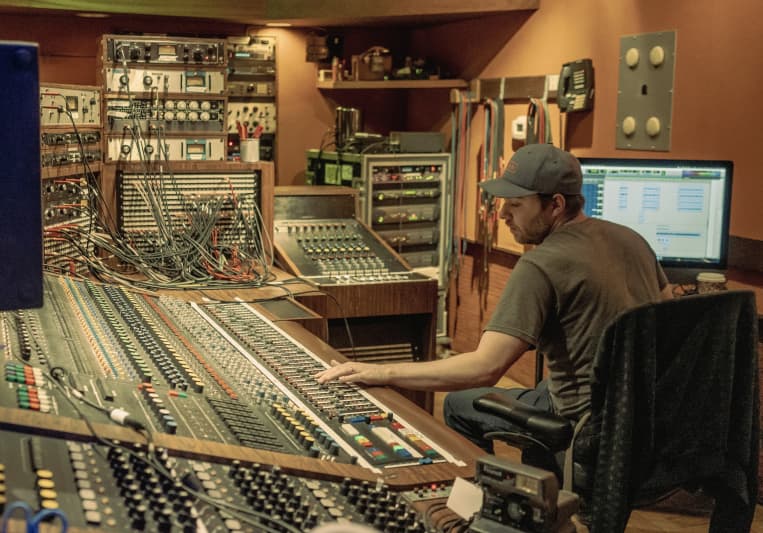
  40. A: I work out of SameSame in Encino, one of the best-sounding rooms I’ve ever worked in. I’ve put a lot into the monitoring and conversion because everything starts with being able to trust what I’m hearing. My preferred setup is ProAc speakers with PMC subs. I use a combination of plugins and analog outboard gear, including vintage 1176s and D.W. Fearn tube EQs. I print the analog processing back into the session, so I get that character while keeping the flexibility of working in the box.

  41. Q: What other musicians or music production professionals inspire you?

  42. A: There are too many to name, and different people inspire me for different reasons. For producers, John Hill, Danger Mouse, Dan Nigro, and Benny Blanco come to mind. For mixers, Serban Ghenea is my benchmark for pop, and I also love Mitch McCarthy and Shawn Everett. My taste in artists is pretty broad: Eminem, The Cure, The Black Keys, Massive Attack, Depeche Mode, The Strokes, and The Killers, alongside Dominic Fike, Lauv, sombr, almost monday, and Young the Giant. It really depends on the song and the world it lives in. I could go on for days.

  43. Q: Describe the most common type of work you do for your clients.

  44. A: Most of my work is mixing and vocal production across pop, indie, alternative, and R&B. I focus on getting the vocal to feel right and making the whole song connect emotionally.

loading
play_arrowpause
skip_previous
skip_next
Raye - Natalie Dont

I was the Mixing Engineer & Vocal Producer in this production

Terms Of Service

- Unlimited Revisions
- Can get on zoom/call for notes (if needed)
- Can do Attended session at our studio in LA (if needed)

GenresSounds Like
  • Pink Sweat$
  • Young the Giant
  • Cage The Elephant
Gear Highlights
  • Analog Outboard Gear
  • PMC Speakers
  • Pro Tools
  • Ableton
More Photos